 Contact Us
 Explore All
October 15, 2026
How Much Does IT Staff Augmentation Cost? [2026]
One of the first questions businesses ask when considering IT staff augmentation is simple....
Posted on August 29, 2023
Updated: September 2026 | Published: August 2023
Quick answer: A Dealer Management System (DMS) is software built for automotive dealerships that runs vehicle sales, spare-parts inventory, workshop service, customer relationships, and accounting from one connected platform, instead of each department working off its own spreadsheet, WhatsApp thread, or paper log. Modern DMS platforms also track vehicles and parts in transit, right up to the point they land on a dealer’s lot.
Note on the acronym: “DMS” is used for several unrelated things, Document Management System, Data Management System, and (in this article) Dealer Management System, the software category built specifically for vehicle dealerships and importers.
Most dealership groups don’t run on one system, they run on five. Sales tracks leads in a spreadsheet. The workshop runs on paper job cards. Parts inventory lives in whatever the last person updated. Accounting finds out about a sale days after it happened. None of these talk to each other, so nobody, not the sales manager, not the importer, not the owner, has one accurate picture of the business at any given moment.
This isn’t a small-market problem. Nepal’s automobile trade association, NADA Automobiles Association of Nepal, represents over 2,800 importers, distributors, and dealers and puts the industry’s annual revenue at roughly NPR 90.05 billion, employing more than a million people directly and indirectly. Globally, the International Organization of Motor Vehicle Manufacturers (OICA) tracks tens of millions of vehicle sales a year, every one of which eventually needs a dealer, a service record, and an inventory line. At that scale, “we’ll track it on a spreadsheet” stops being a workaround and starts being the reason deals get missed and customers get lost.
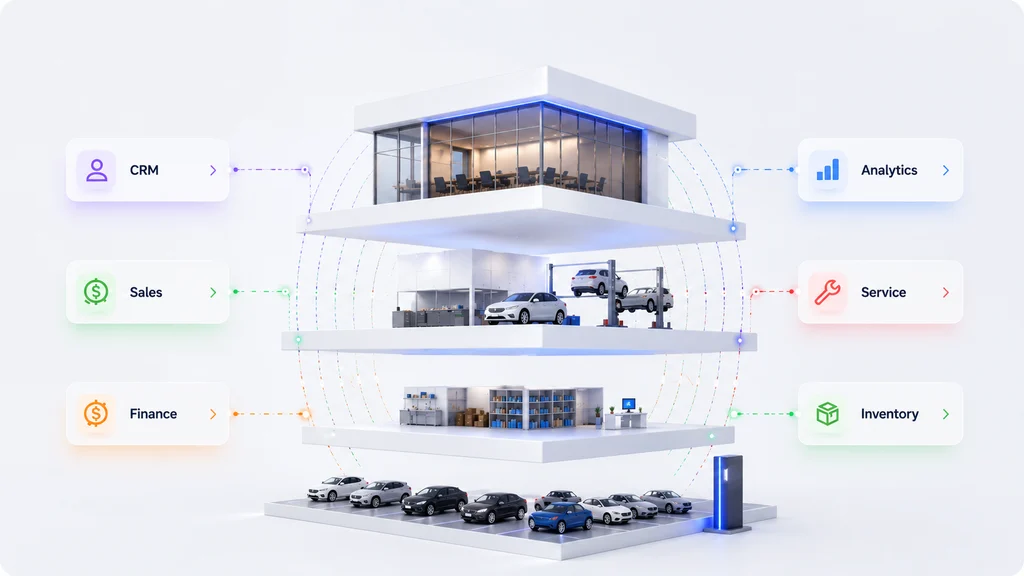
In the automobile industry, DMS refers to the operating system a dealership or importer runs its business on: one platform connecting vehicle and parts inventory, sales and CRM, workshop/service, logistics, and accounting, instead of running each as a disconnected tool. Everyone from a showroom sales executive to a group’s head office works from the same live data, whether it’s one branch or a multi-country distribution network.
A DMS earns the name by covering the full lifecycle of a vehicle, not just the sale. The modules that matter most:
This is one of the most common questions dealership owners search for, and the honest answer is: it depends on where the business is currently losing time and money. The most common gains fall into four categories.
Speed. When sales, service, and inventory are on separate systems, someone has to manually reconcile them, a job that eats hours every week and is always at least a day behind. A connected DMS closes that gap: a vehicle sale updates inventory the moment it happens, not the next morning.
Visibility. An importer or group head office managing multiple dealers can’t act on what they can’t see. A DMS gives that central view, stock levels, sales pace, service backlog, across every branch, in real time, instead of waiting for each location to send its own report.
Fewer errors, less leakage. Manual re-entry between systems is where mistakes happen: a part billed twice, a discount approved outside policy, a vehicle that shows “in stock” when it was sold three days ago. Structured workflows and approval limits close most of these gaps by design.
Customer retention. A DMS with a built-in follow-up module (like a CCD/PSF process) turns a one-time sale into an ongoing relationship, service reminders, satisfaction checks, and renewal prompts that a spreadsheet simply won’t generate on its own.
Autoways Pvt. Ltd., a multi-showroom automotive distributor in Nepal, moved onto Pagoda Labs DMS and measured the change directly:
| Metric | Before | After |
| Stock allocation | Up to 3 days | Real-time |
| Weekly admin overhead per showroom | 15+ hours | Under 2 hours (–86%) |
| Inventory tracking errors | ~12% | 0% |
| Retail deals closed | Baseline | +27% |
| VAT / financial reporting | 10–14 days | Instant |
| Service throughput | 18 vehicles/day | 22 vehicles/day (+22%) |
| Return on investment | Projected 12+ months | Achieved in 7 months |
Those aren’t projections, they’re what changed after go-live across three showrooms and their service centers running on one system instead of three.
They overlap, and the confusion is fair. An ERP (Enterprise Resource Planning) system is a general-purpose platform for running any business’s core functions, finance, HR, procurement, inventory. A DMS is purpose-built for one industry’s specific workflow: vehicle-level inventory (tracked by chassis and VIN, not just SKU), transit and border-checkpoint tracking for imported stock, workshop job cards, and dealer-network management.
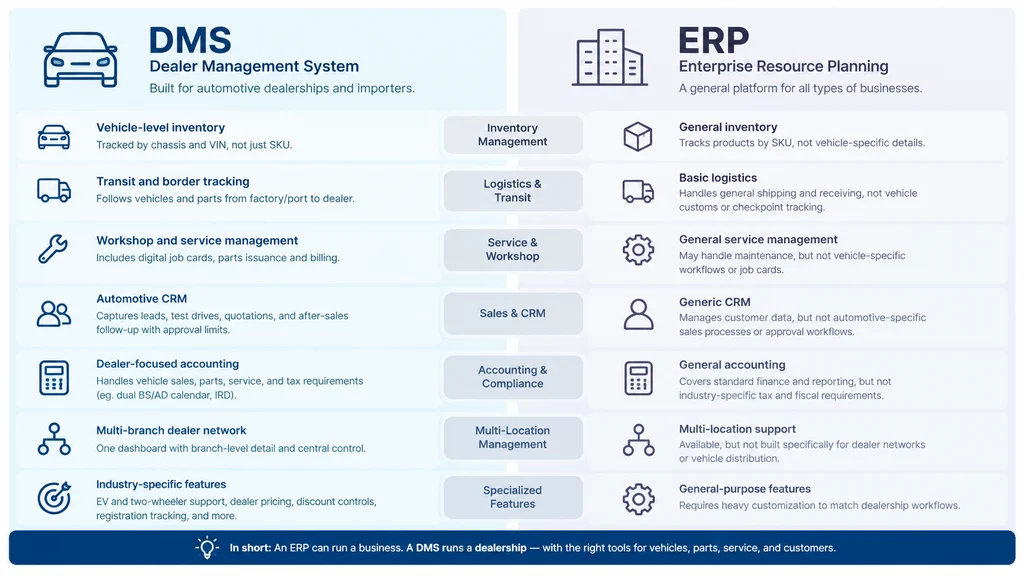
You could force a generic ERP to handle a dealership’s operations, but you’d spend months customizing fields an automotive DMS already has built in, dealer price vs. retail price, discount limits by sales designation, vehicle registration tracking, and a fiscal calendar that matches how the country you operate in actually reports tax.
Before signing with any vendor, run the DMS through these five questions:
We go deeper on the full evaluation process, including questions to ask vendors directly, in How to Select the Right Dealership Management System.
For a broader look at where the region stands, see our Digital Readiness Index for Dealers: South Asia 2026.
Pagoda Labs built DMS specifically around the gaps described above, for automotive dealers, importers, and distributors in Nepal and expanding across South Asia:
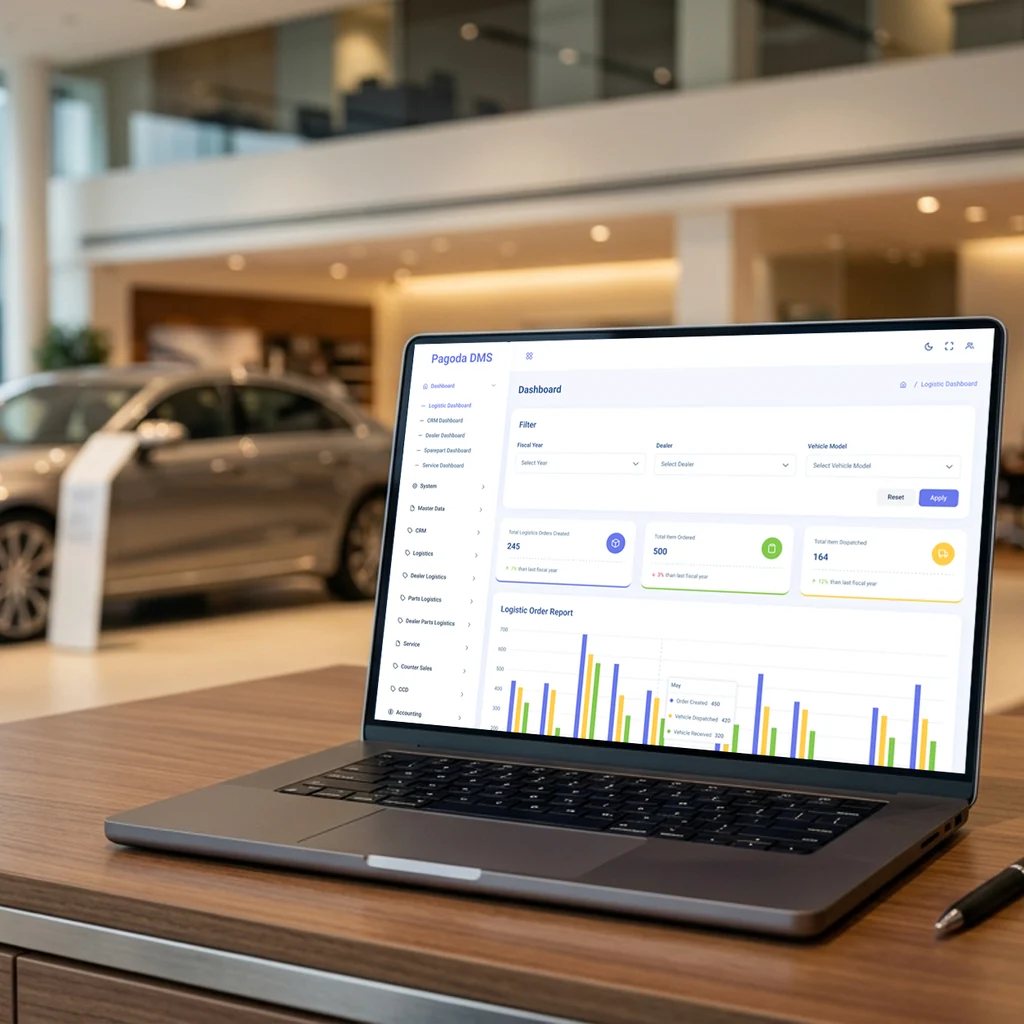
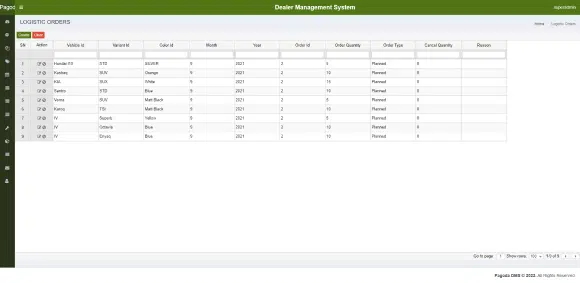
Pagoda Labs DMS is already running across dealer groups including CG Motors, Autoways, SPG Automobiles, Go Automobiles, and Shangrila Motors, and is expanding into Pakistan, Bangladesh, and Sri Lanka. See the full platform on the Automotive Dealer Management System page, or book a free consultation to walk through your specific setup. Pagoda Labs provides automotive dealers with a demo that demonstrates the system’s operational and analytical features.
A dealer management system is software that runs an automotive dealership’s core operations, vehicle and parts inventory, sales and CRM, workshop service, and accounting, from one connected platform instead of separate, disconnected tools.
In the automobile industry, DMS is the platform dealerships and importers use to manage the full vehicle lifecycle: incoming stock and logistics, showroom sales, after-sales service, and the accounting tied to all three, unified across one or many branches.
DMS software connects the departments of a dealership, sales, inventory, service, accounting, so that a transaction in one department (a sale, a parts issue, a service booking) updates the others automatically, instead of requiring manual re-entry.
It reduces the time spent reconciling separate systems, gives management real-time visibility across branches, cuts down on manual-entry errors and unapproved discounts, and supports structured after-sales follow-up that keeps customers coming back.
An ERP is a general business platform (finance, HR, inventory) usable in any industry. A DMS is purpose-built for automotive dealership workflows, vehicle-level inventory, transit tracking, service job cards, and dealer-network management, that a generic ERP doesn’t handle out of the box.
Check whether it tracks a vehicle across its full lifecycle (not just the sale), supports your market’s compliance and fiscal-calendar requirements natively, scales across multiple branches from one dashboard, enforces approval limits rather than just reporting after the fact, and is ready for the vehicle types, including EVs and two-wheelers, your market is moving toward.
A modern DMS is built for both. Multi-branch groups get one centralized dashboard across every location while retaining branch-level detail, rather than needing a separate system per showroom.
Yes, it natively supports the dual Bikram Sambat/Gregorian fiscal calendar and IRD-aligned billing and inventory processes, alongside workflows for petrol, diesel, EV, and two-wheeler inventory, and is expanding across Pakistan, Bangladesh, and Sri Lanka.
One of the first questions businesses ask when considering IT staff augmentation is simple....

When your business needs extra technical support, there are several ways to get it...