 Contact Us
 Explore All
October 07, 2026
Staff Augmentation vs Outsourcing vs Managed Services: Which Model Fits Your Team?
When your business needs extra technical support, there are several ways to get it...

One of the first questions businesses ask when considering IT staff augmentation is simple: how much does it actually cost?
The answer depends on the role, experience level, technology stack, engagement length, and provider. A junior developer and a senior solutions architect will not cost the same, just as a short-term engagement and a long-term placement may have different pricing.
Still, businesses need more than a vague “it depends” answer when they are planning a technology budget.
This guide breaks down IT staff augmentation costs in 2026, including the factors that affect monthly rates, how different roles are typically priced, and how staff augmentation compares with the cost of hiring a permanent employee.
The monthly cost of an augmented developer depends mainly on their experience, technical specialization, and the market they are hired from.
For businesses working with Pagoda Labs, pricing is based on the role and seniority of the professional rather than a single flat rate for every developer.
The monthly rate for staff augmentation is not necessarily comparable to an employee’s salary alone.
A permanent employee can involve recruitment costs, benefits, onboarding, equipment, administrative work, and the time your internal team spends interviewing and hiring. With staff augmentation, much of that overhead is handled by the provider.
Pagoda Labs total cost of an augmented engineer is 40% to 55% lower than an equivalent permanent hire when recruitment, benefits, and onboarding are included. Its headline comparison uses a 55% lower engineering cost figure.
Not every IT professional requires the same level of expertise.
A junior frontend developer, for example, may handle well-defined development tasks under the guidance of a senior engineer. A senior DevOps engineer, on the other hand, may be responsible for infrastructure decisions, deployment systems, security, automation, and cloud architecture.
The more specialized the role, the more the rate can change.
| Developer Type | Responsibilities | Factors Affecting Cost |
|---|---|---|
| Full-Stack Developers | Work across frontend and backend systems. | Experience, frameworks, independence, and technical supervision. |
| Frontend Developers | Develop the user-facing parts of an application. | Framework, design requirements, experience, and product complexity. |
| Backend Developers | Build APIs, databases, business logic, integrations, and server-side systems. | Application complexity, enterprise requirements, and integrations. |
| Mobile Developers | Develop mobile applications for iOS, Android, Flutter, or React Native. | Platform, framework, experience, and development requirements. |
| QA Engineers | Test software, identify defects, and maintain automated testing processes. | Manual testing, automation, performance testing, security testing, or a combination. |
| Cloud and DevOps Engineers | Manage infrastructure, deployment automation, monitoring, cloud architecture, and Infrastructure as Code. | Specialization, cloud platforms, infrastructure complexity, and automation requirements. |
| UI/UX Designers | Support interface design, user journeys, research, and product design. | Experience, design responsibilities, research needs, and scope of work. |
| Solutions Architects | Make broader technical decisions and design systems. | Senior-level expertise and architectural responsibilities. Pagoda Labs includes senior architecture validation in its staff augmentation engagement rather than billing separately. |
At Pagoda Labs, senior architecture validation is included as part of the staff augmentation engagement rather than billed separately.
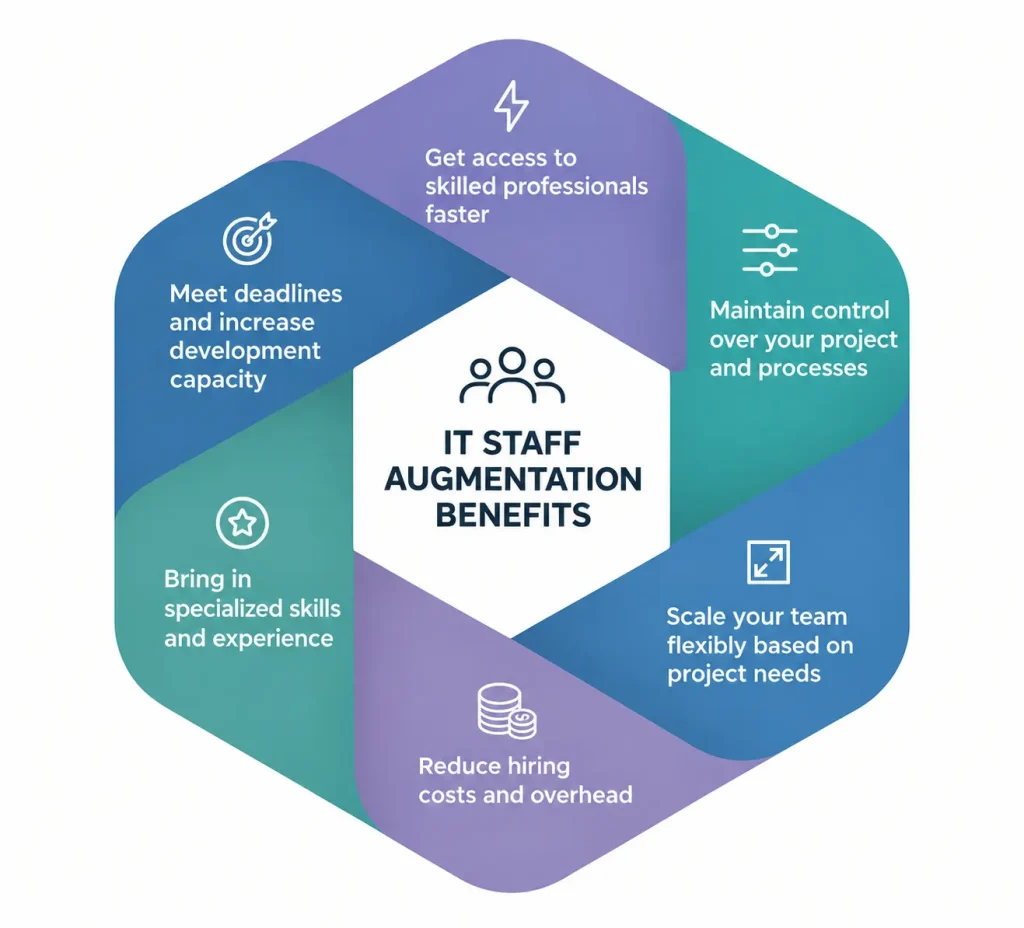
Before comparing costos, understand how the staff augmentation model works, its benefits, and when it makes sense for your business. Read our What Is IT Staff Augmentation? The Complete Guide (2026)
The role is only one part of the calculation. Several other factors can change the final cost.
A junior developer and a senior developer can have very different rates.
Junior professionals may require more direction, while experienced engineers can often take ownership of more complex work and operate with less supervision.
A developer working with a common technology stack may have a different rate from someone with experience in a highly specialized or difficult-to-source technology.
The more specific the requirement, the smaller the available talent pool can become.
Not every developer role has the same responsibilities.
Someone writing features under an existing technical lead has a different scope from someone expected to design architecture, make technical decisions, and lead other engineers.
The length of the engagement can also affect how a provider structures pricing.
A business that needs one developer for several weeks has a different requirement from a company that needs five engineers for twelve months.
Adding one engineer is different from building an entire augmented team.
As the number of professionals increases, the provider may also need to coordinate onboarding, access, communication, and team integration across multiple roles.
The technology you need can have a direct effect on availability and pricing.
A requirement for a common JavaScript framework may be easier to staff than a very specific combination of enterprise systems, cloud infrastructure, and specialized tools.
The biggest mistake businesses can make when comparing staff augmentation with hiring is looking only at salary.
A permanent developer’s salary is just one part of the total employment cost. Recruitment, interviewing, onboarding, benefits, equipment, administrative work, and the time spent by internal employees all add to the real cost.
Staff augmentation moves much of that work to the provider.
Pagoda Labs augmented engineering cost runs 40% to 55% below an equivalent permanent hire when recruitment, benefits, and onboarding are included.
For example, if the total annual cost of employing an equivalent engineer is $100,000, a 40% to 55% reduction would put the comparable augmented cost at approximately $45,000 to $60,000.
That is an illustration of the percentage difference, not a quoted Pagoda Labs rate.
Cost savings are not only about the monthly developer rate. The recruitment process itself can be expensive and time-consuming.
You need to write job descriptions, advertise positions, review applications, conduct interviews, assess technical skills, negotiate offers, complete onboarding, and get the new employee familiar with the company’s systems.
That process can take weeks before the person starts contributing. Pagoda Labs augmented engineers can typically reach active delivery within 5 to 10 business days, compared with a stated average domestic recruitment cycle of 42 days.
For a company facing a project deadline, the value of getting someone working sooner can matter just as much as the difference in monthly cost.
Not necessarily. The price of an augmented engineer should be considered alongside their experience, technical assessment, responsibilities, and the support provided by the staffing company.
For example, a Pagoda Labs engineer is technically assessed before placement, with candidates matched against the client’s technical requirements. Clients can also interview candidates directly before making the final selection.
This is why comparing providers purely by hourly or monthly rate can be misleading.
A lower rate may not represent better value if the engineer requires significantly more supervision or lacks the skills needed for the project.
Staff augmentation is not limited to short projects. Some businesses use augmented engineers for several months, while others continue the engagement for longer periods because the additional skills remain useful.
The main advantage is that the business does not necessarily have to turn every temporary need into a permanent position.
Our engagements are scalable based on project requirements, without notice periods or severance obligations.
This can be particularly useful for companies whose development workload changes throughout the year.
A simple way to estimate your budget is:
Monthly cost = Number of professionals × Monthly rate per professional
For example, if you need:
Your monthly budget would be the combined monthly rates for those four professionals.
You can then multiply that figure by the expected engagement length.
The number of professionals you need can also change the total budget significantly.
This is useful when you have a specific skills gap.
For example, your existing team may have enough developers but need one experienced DevOps engineer.
A small augmented team can add meaningful development capacity while still working closely with your existing employees.
This can work well when a company needs to accelerate a product roadmap or meet a deadline.
Larger teams may be appropriate when the company needs several different skill sets, such as frontend, backend, QA, mobile, and DevOps.
At this point, it becomes important to think about team structure as well as cost.
You need to make sure the additional engineers have clear responsibilities and that someone on the client side can coordinate the work.
Pagoda Labs has a 40% to 55% lower total engineering cost compared with an equivalent permanent hire when recruitment, benefits, and onboarding are included.
The exact savings for your business will depend on the role, location, seniority, hiring costs, benefits, and length of the engagement.
For example, a business hiring a senior engineer in a high-cost market may see a very different total saving from a business hiring a junior developer in a lower-cost market.
This is why a direct comparison should always use the total cost of each option rather than salary alone.
Before signing an agreement, ask the provider:
Getting these answers upfront makes it much easier to compare providers.
If you are already evaluating providers, our guide [How to Choose a Staff Augmentation Partner: 7 Questions to Ask Before You Sign] covers the wider questions to ask before committing to a provider.
Pagoda Labs provides pre-vetted engineers across several technical roles, including full-stack development, cloud and DevOps, mobile development, automated QA, UI/UX, and solutions architecture.
Our augmented engineers can typically be onboarded within 5 to 10 business days, and that total engineering cost can be 40% to 55% lower than an equivalent permanent hire when recruitment, benefits, and onboarding are included.
The service also includes technical assessment before placement, direct client interviews, and a replacement guarantee within the terms of the service agreement.
Reach out to Pagoda Labs for IT Staff Augmentation service discussion covering your requirements and get current pricing for the roles you need.
There is no single monthly rate for every developer. Cost depends on experience, technical skills, role, engagement length, and provider. Pagoda Labs states that its current rates vary by role and seniority.
It can be. Pagoda Labs total cost for an augmented engineer is 40% to 55% lower than an equivalent permanent hire when recruitment, benefits, and onboarding are included.
This depends on the provider. Businesses should check whether technical screening, recruitment, onboarding, management, infrastructure, replacement coverage, and other services are included in the quoted rate.
Yes. Senior professionals generally have different rates from junior and mid-level professionals because they bring different levels of experience, technical responsibility, and independence.
Many providers structure staff augmentation around monthly rates, although pricing models can vary. Always confirm whether the quoted rate is monthly, hourly, or based on another arrangement.
When your business needs extra technical support, there are several ways to get it...

Payroll in Nepal isn’t about calculating salaries anymore. Between social security fund contributions, provident fund deductions, income tax...