 Contact Us
 Explore All
October 15, 2026
How Much Does IT Staff Augmentation Cost? [2026]
One of the first questions businesses ask when considering IT staff augmentation is simple....
Posted on July 31, 2026
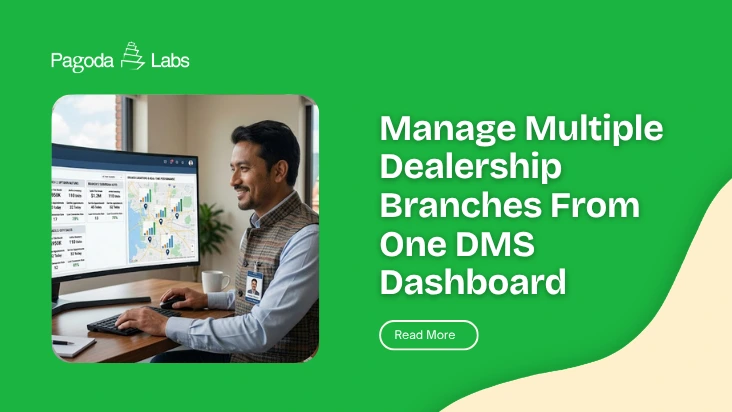
Running one dealership branch well is hard enough. Running multiple can mean five sets of stock records, five sales teams, five service departments, and a growing gap between what’s actually happening on the ground and what head office can see. Most dealerships hit this wall the same way: by adding more spreadsheets, more phone calls, and more end-of-month reconciliation, until it becomes clear that approach doesn’t scale.
Here’s how a dealer management system solves the multi-branch visibility problem, and what to look for if you’re managing multiple branches or planning to get there.
When each branch runs on its own local process, whether that’s a spreadsheet, a paper log, or a disconnected point-of-sale tool, head office ends up piecing together a picture of the business after the fact instead of seeing it in real time.
A few specific ways this shows up:
This is the core problem that a connected DMS is built to solve, replacing different separate pictures with one accurate view.
For multi-branch visibility to work in practice, a dashboard needs to pull together specific categories of information, not just a general overview.
1. Real-time stock levels by branch. Know exactly what’s available, what’s in transit, and what’s already committed to a customer, without waiting on someone to check manually.
2. Sales performance against targets. See how each branch is tracking day by day, not just at month-end when it’s too late to adjust course.
3. Service activity across all locations. Job cards, technician assignments, and service records need to stay current across every branch, visible from one place.
4. Customer records that follow the customer. Whichever branch a customer walks into, staff should be able to pull up their full purchase and service history immediately.
5. Financial performance by branch and combined. Revenue from retail sales, wholesale dispatch, and service should be visible both branch by branch and rolled up together.
Without all five of these connected, you end up with partial visibility that still requires manual work to complete the picture.
One of the biggest advantages of running multiple branches on one system is that vehicle inventory and customer records update automatically across every location. A sale at branch one is reflected everywhere else immediately, so stock numbers never fall out of sync.
This matters in a few specific situations:
Centralizing this data doesn’t mean branches lose autonomy over daily operations. It means the numbers behind those operations are consistent and current no matter which branch is being looked at.
Tracking leads and sales the same way across all branches is one of the harder parts of scaling a dealership network, especially if each branch has developed its own informal process over time.
A connected CRM built into the DMS addresses this by:
This consistency is what lets head office actually compare performance across branches on equal footing, instead of comparing all different reporting styles.
Service departments are often where multi-branch visibility breaks down hardest, since job cards, technician schedules, and parts usage can pile up fast across all different separate workshops.
A dashboard that keeps this connected should let you:
1. See job cards update in real time across all branches, not just the one you happen to be checking.
2. Track parts inventory used in service so a branch running low doesn’t find out only when a technician can’t complete a job.
3. Monitor service turnaround times across locations to spot which branches are falling behind and why.
This kind of visibility turns service monitoring from a reactive process into something head office can actually manage proactively.
Accounting is often the last place multi-branch visibility catches up, since revenue streams from retail sales, wholesale dispatch, and service all need to be pulled together and measured against operational costs.
A DMS with accounting built into the same system as sales, service, and inventory means:
Moving all branches onto one system doesn’t need to happen all at once. Implementation is typically modular, meaning sales, service, and logistics functions can go live in stages rather than requiring every branch to switch everything on the same day.
A practical rollout usually looks like this:
1. Start with one branch as a pilot, working out any adjustments needed before expanding further.
2. Migrate existing data as you go, so vehicle records, customer history, and inventory aren’t lost in the transition.
3. Bring branches online in stages, giving each team time to adjust without disrupting daily sales and service activity.
4. Expand visibility gradually, starting with stock and sales data before layering in service and financial reporting across all locations.
This staged approach is what makes a multi-branch roll out manageable instead of overwhelming for both head office and branch staff.
If you’re managing multiple dealership branches and struggling to get one accurate picture of the business, Pagoda Labs’ Automotive Dealer Management System is built to bring that visibility together. Get in touch to see how it fits your network.
It depends on the rollout approach, but implementation is usually staged, with one branch or one function going live at a time rather than all branches switching over at once.
No. A connected dashboard centralizes data visibility, not day-to-day decision-making. Branch teams still run their local operations, but head office and other branches can see accurate, current information.
Existing vehicle inventory, customer history, and service records are typically migrated into the new system during setup, so branches don’t start from scratch.
Yes. With sales, service, and inventory data unified in one dashboard, comparing branches becomes a matter of looking at the same view rather than waiting on separate reports from each location.
No. Sales, service, and logistics can go live in stages, which lets a larger network transition without disrupting operations across all branches at once.
One of the first questions businesses ask when considering IT staff augmentation is simple....
When your business needs extra technical support, there are several ways to get it...