 Contact Us
 Explore All
October 15, 2026
How Much Does IT Staff Augmentation Cost? [2026]
One of the first questions businesses ask when considering IT staff augmentation is simple....
Posted on August 27, 2026
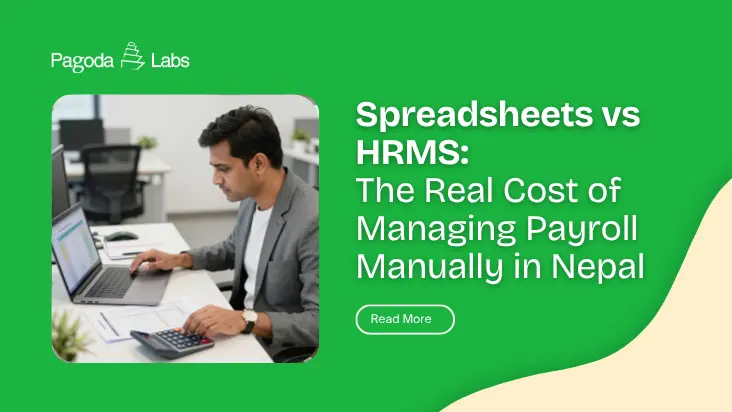
Payroll in Nepal isn’t about calculating salaries anymore. Between social security fund contributions, provident fund deductions, income tax withholding, and the paperwork that comes with all three, running payroll manually in a spreadsheet has gotten a lot riskier than it used to be. Yet plenty of growing businesses in Nepal still process payroll this way, often because it’s what they’ve always done, not because it’s still the right fit.
Here’s a real look at what manual payroll actually costs a business in Nepal, and where an HRMS closes the gap.
For a small team of five or ten people, a spreadsheet can genuinely work. Someone enters hours, applies a formula, and salaries go out. The problems tend to show up as headcount grows or compliance requirements get more complex, which is exactly where many Nepali businesses find themselves right now.
A few signs a business has outgrown spreadsheet payroll:
Nepal’s payroll compliance requirements have gotten more demanding, particularly since Social Security Fund enrollment became mandatory for formal sector employers under the Contribution-Based Social Security Act. Employers are required to make monthly contributions on behalf of every employee, calculated against basic remuneration, alongside the employee’s own contribution.
Manual payroll processes struggle here for a few specific reasons:
1. Contribution calculations need to be exact every month. Getting the percentage split between employer and employee contributions wrong, even slightly, creates a compliance problem that compounds over time.
2. Late or missed deposits carry real penalties. Nepali law allows for fines and, in serious cases, imprisonment for employers who fail to register or contribute on time, which makes manual tracking a genuine business risk, not just an inconvenience.
3. Audit readiness is a constant requirement, not a once-a-year task. Inspectors have the authority to review payroll and employer records at any time, and a business relying on scattered spreadsheets can struggle to produce a clean, complete record on short notice.
4. Employee claims for medical, accident, or maternity benefits require accurate contribution history. If records are inconsistent or incomplete, employees can face delays accessing benefits they’re entitled to.
This is where the real cost of manual payroll shows up. It’s not just the hours spent calculating numbers; it’s the exposure a business carries if those numbers are wrong.
The visible cost of spreadsheet payroll is staff time. The less visible cost is everything that happens when something goes wrong.
An HRMS built around payroll automation addresses these problems at the source, rather than adding another layer of manual checking on top of the same process.
Here’s what that looks like in practice:
1. Payroll calculations pull directly from attendance, leave, and benefits data. Instead of someone manually entering hours and applying formulas, the numbers feeding into payroll are already accurate and current, which removes a major source of manual error.
2. Leave and attendance update automatically. Approved leave requests adjust attendance and leave balances the moment they’re approved, so payroll doesn’t need a separate manual reconciliation step.
3. Loans, allowances, and bonuses apply automatically to payroll. Repayments and benefit deductions get built directly into each payroll run instead of being tracked separately and then applied by hand.
4. Every payroll action leaves an audit trail. Approvals, edits, and role changes are recorded automatically, which means compliance questions can be answered by pulling a report instead of digging through old files.
5. Attendance tracking happens in real time, whether through manual check-in or biometric integration, so payroll is always working from current data rather than end-of-month estimates.
Businesses that move payroll off spreadsheets and onto an automated HRMS can reduce payroll processing time by 50–80%, while significantly cutting repetitive administrative work. In one Nucleus Research study, automated payroll reduced processing time by 80%.
Attendance accuracy also improves significantly once tracking happens in real time rather than through manual registers, since the numbers feeding into payroll reflect what’s actually happening day to day rather than what got logged after the fact. Real-time attendance tracking can also improve payroll accuracy. A 2026 study reported accuracy increasing from 92% to 99.7% while manual corrections fell by 80% after implementing automated time-and-attendance processes.
Not every HR system is built with Nepal’s specific compliance landscape in mind. A few things worth checking before choosing one:
Moving from spreadsheets to an HRMS doesn’t need to happen overnight. A practical approach usually looks like this:
1. Start with attendance tracking, since accurate attendance data is the foundation that payroll calculations depend on.
2. Bring leave and approval workflows online next, so leave balances and attendance stay connected automatically.
3. Layer in payroll automation once attendance and leave data are stable, letting the system calculate salaries from data that’s already accurate.
4. Add performance management and reporting last, building on a payroll foundation that’s already solid.
This staged approach means a business isn’t trying to overhaul its entire HR process in one go, which reduces the risk of disruption during the transition.
If manual payroll is starting to feel like more risk than it’s worth, Pagoda Labs’ Human Resource Management System is built to bring payroll, attendance, and compliance into one connected process. Get in touch to see how it fits your team.
Both. Beyond the time cost, manual payroll carries real compliance risk in Nepal given the accuracy required for Social Security Fund and provident fund contributions, along with penalties for late or incorrect deposits.
A well-built HRMS calculates statutory deductions automatically as part of payroll processing, pulling from accurate attendance and benefits data rather than requiring manual calculation each month.
It doesn’t need to. Implementation is typically staged, with attendance, leave, and payroll functions going live in phases rather than switching everything on at once.
Current employee records, attendance history, and payroll data are migrated into the new system during setup, so businesses don’t lose historical information or start from scratch.
No. Even growing teams with a modest headcount benefit once payroll complexity, compliance requirements, and attendance tracking start outpacing what a spreadsheet can reliably handle.
One of the first questions businesses ask when considering IT staff augmentation is simple....

When your business needs extra technical support, there are several ways to get it...